
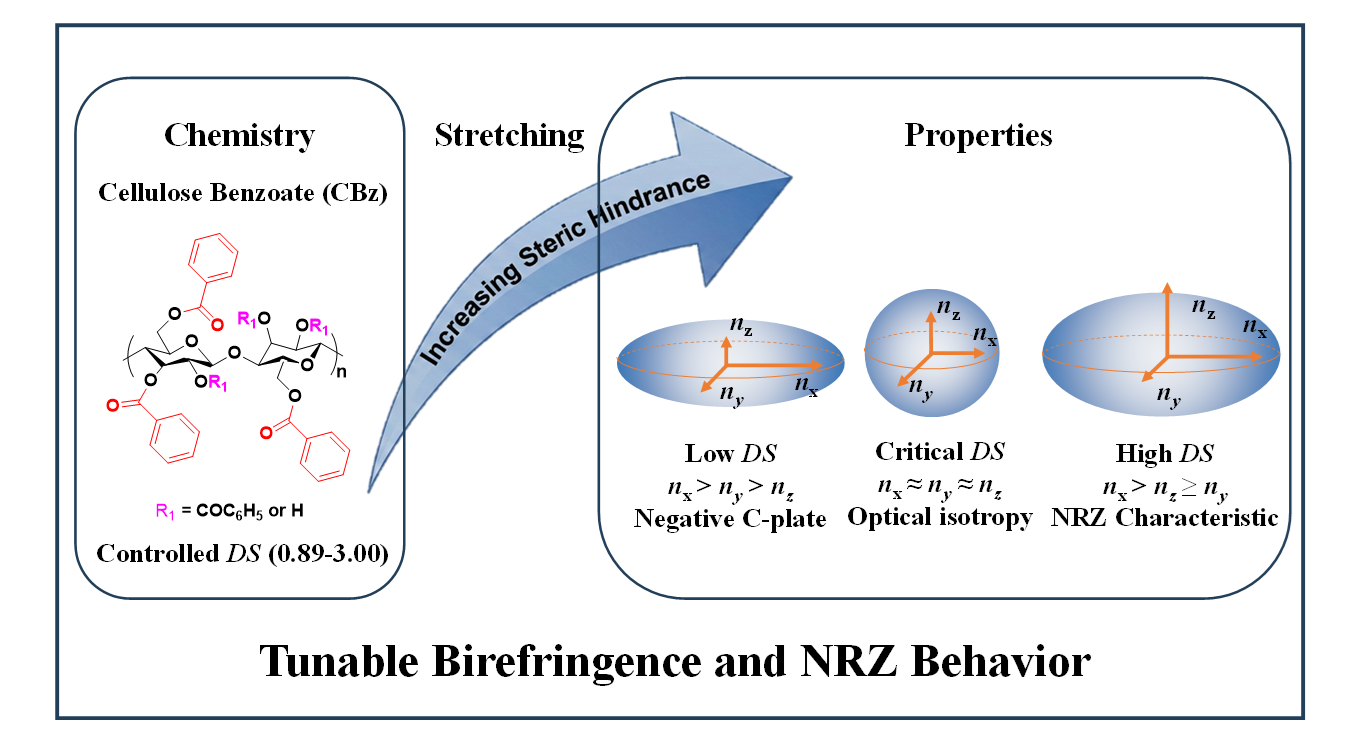
Recently, under the joint supervision of Prof. Liangbin Li and Research Prof. Xueyu Li, doctoral student Wenhao Guo and other team members focused on the application of cellulose-based sustainable optical films in novel display technologies, specifically investigating the homogeneous synthesis and stretching orientation mechanisms of cellulose benzoate films. Through systematic characterization and macroscopic optical property testing, the team revealed the structure-processing-property relationship governed by the competitive orientation between the cellulose main chain and bulky side groups. This provides scientific guidance for the design and manufacturing of high-performance bio-based optical compensation films. The related work was published in the journal ACS Applied Polymer Materials.
In this work, the preparation process and structural characteristics of optical compensation films—a critical core material in novel display technologies such as liquid crystal displays (LCDs) and organic light-emitting diodes (OLEDs)—were explored in depth. As an essential component of wide-color-gamut display panels, optical compensation films currently rely heavily on petroleum-based materials, while conventional bio-based alternatives (such as cellulose triacetate) face the challenge of a restricted birefringence tuning window. To overcome this material limitation, the fundamental scientific issues of cellulose benzoate (CBz) with precise degrees of substitution during processing were investigated in detail to analyze and establish the relationship between macroscopic properties and microscopic structures. This involved utilizing a homogeneous ionic liquid platform to synthesize materials with varying degrees of substitution, followed by uniaxial stretching. The team discovered a non-monotonic V-shaped dependence of birefringence on the degree of substitution, elucidated the steric hindrance-driven side-group orientation inversion mechanism, and successfully achieved precise tailoring of the films' three-dimensional refractive indices (encompassing zero birefringence, anomalous negative-to-zero characteristics, and positive C-plate behavior). This establishes a scientific foundation for the manufacturing of high-performance, eco-friendly optical compensation films.
This research was jointly funded and supported by the Chinese Academy of Sciences Project (JZHKYPY-2021-04) and the LCD Polarizer Compensation Film Project.
Wenhao Guo, Zhouhang Lei, Xingyue Fang, Zhengqi Tan, Xueyu Li*, and Liangbin Li*.Benzoate-Substituted Cellulose Films with Tunable Birefringence and Anomalous Optical Anisotropy[J].ACS Applied Polymer Materials, 2026.
Paper Link: https://doi.org/10.1021/acsapm.5c04814