
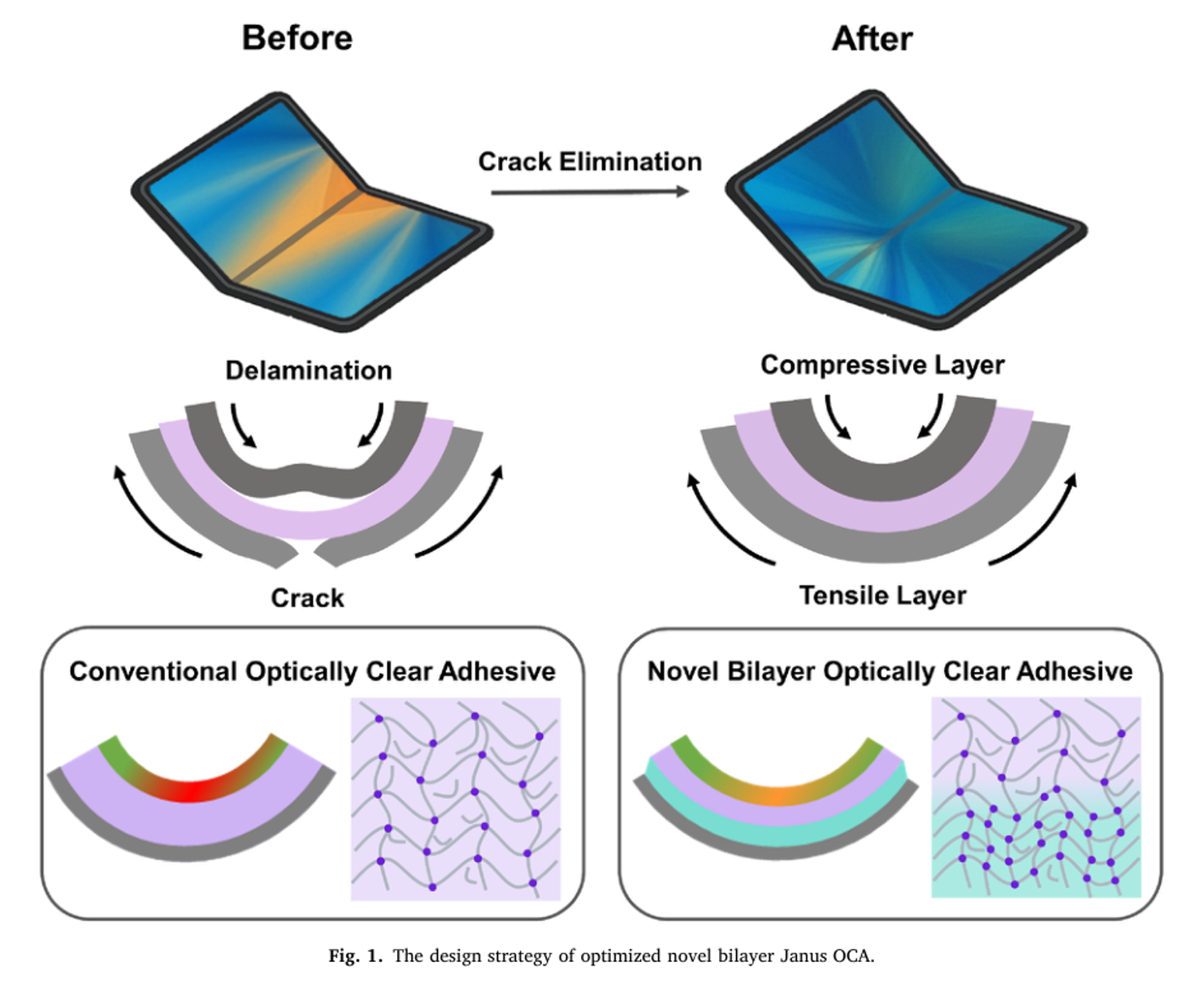
Recently, our team, under the guidance of Professor Wei Chen, conducted research on the structural design and performance regulation of optical transparent pressure-sensitive adhesives (OCA) for foldable displays. A new strategy was proposed for a dual-layer Janus OCA with a crosslinking density gradient. This work, led by master's student Jiaying Deng and others, addresses issues in traditional OCAs, such as screen creases, interface failure, and uneven stress distribution during repeated folding. By constructing an asymmetric structure with a low crosslinking density layer—high crosslinking density layer along the thickness direction, a balance was achieved between interfacial adhesion and internal cohesion. The research shows that this dual-layer design not only maintains excellent optical performance but also significantly improves the material's mechanical response and folding reliability, providing a new approach for the design of key adhesive layers in next-generation flexible and foldable display devices.
In this study, three types of single-layer OCAs and their corresponding dual-layer structures were systematically developed. The network structure was quantitatively characterized using low-field nuclear magnetic resonance (LF-NMR), double-quantum nuclear magnetic resonance (DQ-NMR), and single-side nuclear magnetic resonance (UNMR). Among them, UNMR, with a spatial resolution of 10 μm, directly verified the crosslinking density gradient along the thickness direction of the dual-layer adhesive film. Performance tests showed that all OCA samples had a transmittance higher than 95% and a haze lower than 0.6% within the visible light range, meeting the requirements for optical transparent adhesives in display applications. Compared to single-layer high-crosslink samples, the dual-layer Janus OCA exhibited better creep recovery ability while maintaining a high peel strength, and it demonstrated superior durability in both static and dynamic folding tests. Notably, when the dual-layer adhesive film M62 was attached to ITO on the low crosslinking density side, it showed the best dynamic folding stability, indicating that this asymmetric gradient structure could more effectively distribute stress, suppress cracks, and prevent interface delamination, thus enhancing the service reliability of foldable display devices.
This research, starting from the polymer network structure, reveals the role of crosslinking density as a key structural parameter in modulating modulus, viscoelastic response, deformation ability, and stress redistribution during the folding process. It also proves the application potential of Janus gradient design in the development of high-performance OCAs. The results provide experimental evidence and theoretical references for the precise design and performance optimization of optical transparent pressure-sensitive adhesives in the field of flexible displays.
This research was supported by the National Natural Science Foundation of China (52422302), the Anhui Provincial Natural Science Foundation (2408055UM001, 2308085UM02, 2208085UM01, 2208085UM04), and the Chinese Academy of Sciences (JZHKYPT-2021-04).
Jiaying Deng, Lei Wu, Xiaojie Chen, Lingxun Qi, Haotian Wu, Jie Chen, Sarah Palloks, and Wei Chen*.Janus optical clear adhesive with tunable crosslinking density gradient for foldable display[J].Polymer, 2026, 351: 129841.
Paper Link:https://doi.org/10.1016/j.polymer.2026.129841