Doctoral student Kaining He and colleagues in our team, under the joint supervision of Professor Kunpeng Cui and Professor Xueyu Li, systematically investigated the stress relaxation mechanism of dually crosslinked tough polyampholyte hydrogels under multiaxial deformation modes. The related work was published in Macromolecules.
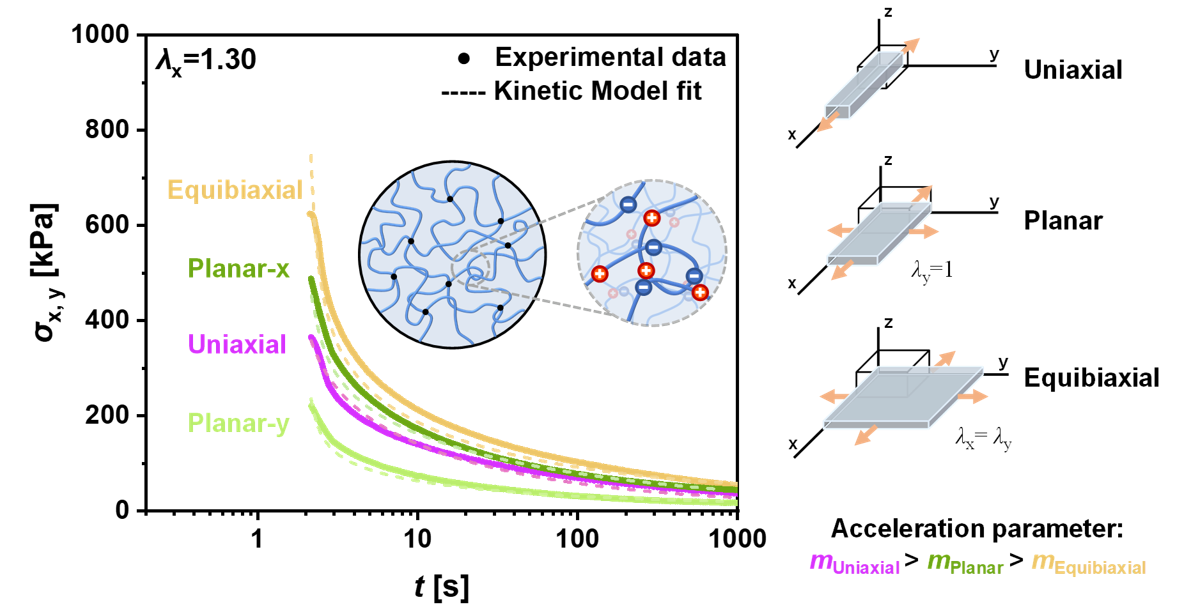
In this work, we systematically examined the stress relaxation behavior of polyampholyte (PA) hydrogels containing both chemical crosslinks and strong ionic-bond physical crosslinks under uniaxial, planar, and equibiaxial deformation modes. Using a biaxial stretching apparatus independently developed in our laboratory, we obtained extensive stress relaxation data under different deformation modes and introduced an accelerated rupture parameter, m, to quantitatively describe the strain-accelerated rupture process of ionic bonds.
The study revealed that the rupture kinetics of ionic bonds exhibit damage anisotropy. During deformation, uniaxial stretching allows greater lateral contraction freedom of polymer chains, which more readily leads to pronounced local stress concentration and thus the fastest ionic bond rupture. In contrast, under equibiaxial stretching, the network is constrained in multiple directions, which relatively alleviates such stress concentration and results in the slowest rupture. This trend was quantitatively described by the accelerated rupture parameter as m Uniaxial > m Planar > m Equibiaxial.
Based on these findings, building upon our previous work on a uniaxial constitutive model, we further developed a transient network constitutive model applicable to multiaxial stretching. In this model, the total stress is decoupled into three contributions: the chemical network, the remaining physical bonds, and the reformed physical bonds. The fitted parameters enable prediction of the nonlinear relaxation process of the gel under complex multiaxial states.
Different from previous studies that were mainly limited to uniaxial testing, this work systematically investigated stress relaxation behavior under multiaxial deformation modes and revealed the dissociation kinetics of strong physical crosslinks from the perspective of “damage anisotropy.” These findings provide new insights for the design of advanced soft materials, such as flexible actuators and artificial cartilage, intended for long-term service under complex loading conditions.
This work was supported by the National Natural Science Foundation of China (52273028 and U2430213).
He,K.; Huang, S.; Zhu, J.; Chu, Z.; Li, Y.; Li, L.; Li, X.; Cui, K.,Multiaxial stress relaxation of dually crosslinked tough polyampholyte gel. Macromolecules 2026, 59(9): 5325-5337.
Paper Link: https://doi.org/10.1021/acs.macromol.6c00198