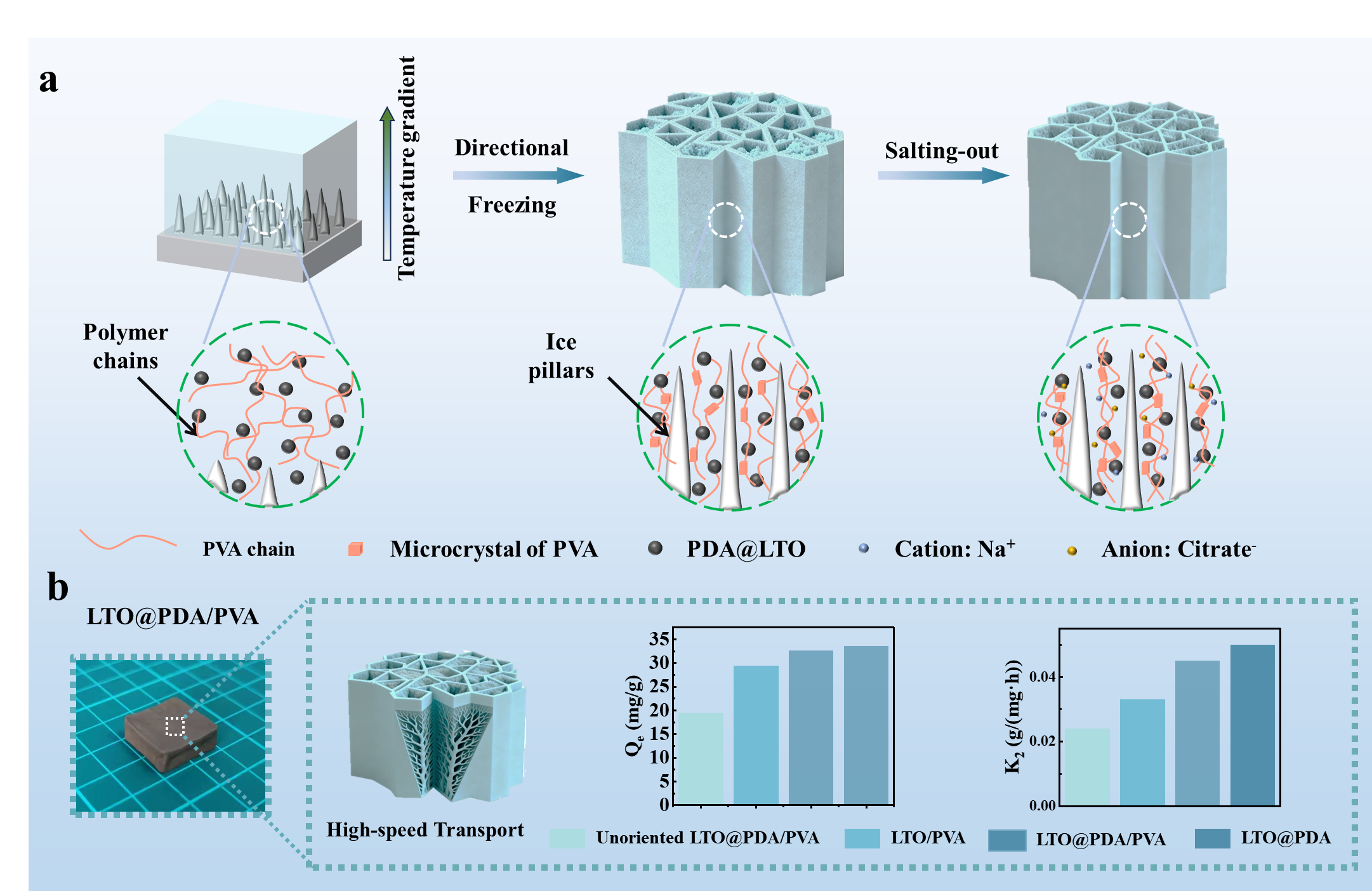
Doctoral student Xunshuang Zhang and co-workers from our team, under the joint supervision of Researcher Liangbin Li and Professor Yanan Ye, focused on key technologies for efficient and selective lithium extraction from salt-lake brines. By integrating directional freeze casting with dopamine-mediated interfacial modification, they developed, for the first time, an LTO@PDA/PVA composite adsorbent featuring directional dendritic through-channels. This design successfully addresses engineering bottlenecks associated with conventional powdered lithium-ion sieves, including particle aggregation, slow masstransfer, difficult recovery, and poor cycling stability, providing a new material strategy and design principle for lithium extraction from complex salt-lake systems. The related research results have been published in Desalination.
In this study, the team uniformly immobilized dopamine-coated lithium metatitanate particles (LTO@PDA) within a PVA matrix and constructed continuous dendritic ion-transport channels through directional freeze casting. The structure–performance–mass transfer relationship was systematically elucidated. Experimental results showed that dopamine modification significantly improved the dispersibility and hydrophilicity of LTO, suppressed particle aggregation, and fully exposed lithium-exchange sites. Meanwhile, the directional dendritic channels greatly shortened ion-diffusion pathways and substantially enhanced mass-transfer efficiency, enabling rapid lithium-ion adsorption. In simulated Qarhan salt-lake brine, the adsorbent exhibited consistent performance advantages: the lithium adsorption capacity reached 25.47 mg·g⁻¹ within 24 h, and the separation factors for Na⁺, K⁺, Ca²⁺, and Mg²⁺ reached up to 822.78, demonstrating excellent anti-interference selectivity.
Despite differences in initial structure and ionic environment, the team identified a common rule: directional dendritic channels can simultaneously improve adsorption kinetics and cycling stability. After 30 consecutive adsorption–desorption cycles, the adsorbent retained no less than 86.7% of its adsorption capacity, while the titanium dissolution rate was as low as 0.3% per cycle. XPS characterization confirmed that Li⁺ adsorption mainly proceeds through Li⁺/H⁺ ion exchange. The dopamine layer assists mass transfer and dispersion through electrostatic interactions but does not participate in the core chemical adsorption process. Based on these key findings, the team proposed an efficient lithium-extraction material design strategy that combines directional dendritic channels with dopamine-mediated interfacial modification. The resulting LTO@PDA/PVA adsorbent integrates high mechanical strength, rapid mass transfer, high selectivity, and long cycling life, making it directly compatible with engineering applications for lithium extraction from salt-lake brines.
This work is the first to introduce a directional dendritic structure into the shaping design of lithium adsorbents. It establishes a quantitative correlation between ion-transport channel structure and lithium-extraction performance, deepens the understanding of the structure–mass transfer–selectivity synergy in polymer composite lithium-ion sieves, and provides key experimental evidence and a technical route for developing engineerable, long-life, and highly selective materials for lithium extraction from salt-lake brines.
This work was supported by the National Natural Science Foundation of China (52303028), the Institutional Platform Project (JZHKYPT-2021-04), and the Innovation Development Fund of the China Innovation Alliance of Uranium Extraction from Seawater (Nos. CNNC-HSTY-2024-003 and CNNC-CXLM-202207).
Xunshuang Zhang, Yiming Hua, Mengyu Xie, et al. Dopamine-coated LTO particles immobilized in PVA with directional dendritic channels for fast and selective lithium capture from salt-lake brines[J].Desalination,2026: 120225.
Paper Link: https://doi.org/10.1016/j.desal.2026.120225