
On October 14, 2026, a faculty and student delegation from the Anhui Provincial Engineering Research Center for Advanced Functional Polymer Films (the Center) at the University of Science and Technology of China (USTC) visited Anhui Wanwei Group for technical exchanges through the USTC–Wanwei Joint Laboratory for PVA New Materials (the Joint Laboratory). The visit included on-site inspections and discussions on production-line optimization and performance improvement for high-strength, high-modulus poly(vinyl alcohol) (PVA) fibers. Through industry–education integration and joint university–enterprise training, the exchange aimed to address critical technological bottlenecks in high-strength, high-modulus PVA fibers for cement reinforcement. Participants included the Center’s doctoral student Hao Sun and master’s students Zhenran Xu, Bixing Wei, and Jiahui Wang, as well as Can Zhou, a doctoral student jointly trained by the university and enterprise through the Joint Laboratory under the university–enterprise joint training model of the Anhui Institute of Advanced Studies.
PVA fiber-reinforced cementitious materials are composites in which high-strength, high-modulus PVA fibers are incorporated into a cementitious matrix to enhance material performance. These fibers can improve crack resistance, impact resistance, and durability, offering application potential in water conservancy and hydropower projects, transportation infrastructure, and structural repair, together with environmental advantages. At present, China’s supply of high-end, high-strength, high-modulus PVA fibers for cement reinforcement remains partly dependent on Kuraray Co., Ltd. of Japan. Advancing domestic alternatives is therefore important for ensuring greater autonomy and control over the supply of these engineering materials.
During the visit, Plant Director Wang and Manager Shen of Wanwei welcomed the Center’s delegation and led a tour of the PVA fiber production line. On-site measurements were taken of physical parameters at key sections of the production line, providing firsthand engineering data for subsequent theoretical analysis and process optimization.
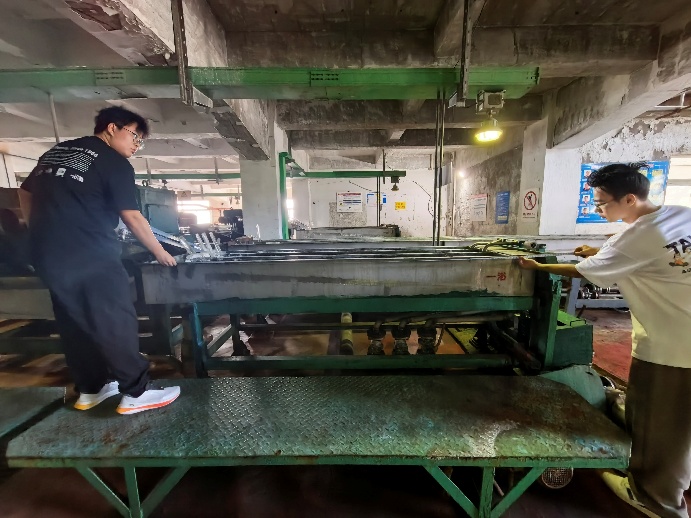
Figure 1. Graduate students Bixing Wei (far left) and Zhenran Xu (far right) from the Center measure key process parameters on the production line.
At the subsequent technical meeting, Wanwei Group’s technical representative outlined the stringent requirements that major national hydropower projects place on materials for reinforcing concrete. As an important clean-energy project in southwestern China, the Yajiang Hydropower Station requires its dam concrete to withstand high water pressure, large temperature variations, and long-term geological stresses, placing high demands on crack resistance, impact toughness, and durability. Existing conventional PVA fiber products face challenges including insufficient single-filament strength and difficulties in controlling interfacial bonding with the concrete matrix. In addition, poor dispersion of bundled fibers during on-site construction limits their reinforcing effectiveness. Together, these issues constitute key bottlenecks to their large-scale application in major engineering projects.
Following in-depth discussions of these industrial challenges, the two sides identified two principal directions for joint research and development. The first is to investigate modifications that enhance the performance of individual PVA fibers, using molecular-chain design, crystallinity control, and surface modification to further improve tensile strength, elastic modulus, and alkali resistance. The second is to develop efficient dispersion technologies for bundled fibers and new PVA fiber products that combine good bundling characteristics with effective dispersion during construction, addressing fiber agglomeration in engineering applications. Under the agreed division of responsibilities, the student team will use the Center’s advanced characterization facilities to optimize material formulations and conduct laboratory performance tests, while Wanwei Group will provide pilot-scale production support and validation in engineering applications.
As a leading enterprise in China’s PVA industry, Wanwei has established large-scale production capabilities and extensive engineering experience in high-strength, high-modulus PVA fibers. Drawing on USTC’s theoretical expertise in polymer processing–structure–property relationships, the Center’s team proposed targeted improvements to the existing production line in areas including draw-induced orientation, crystallization control, heat treatment, and interfacial compatibility between fibers and cementitious matrices. The objective is to improve PVA fiber strength and modulus and provide technical support for developing domestic alternatives to the high-end, high-strength, high-modulus PVA fiber products supplied by Japan’s Kuraray Co., Ltd. for cement reinforcement.
The exchange emphasized the integration of industry and education. Wanwei provided real production-line settings, engineering constraints, and validation conditions, while the Center contributed mechanistic analysis, characterization strategies, and optimization approaches. By combining their complementary strengths to address critical technological bottlenecks, the partners sought to shift production-line optimization from empirical trial and error toward mechanism-based approaches. The visit also provided an opportunity for hands-on training for graduate students jointly trained by the university and enterprise through the Joint Laboratory. Doctoral student Can Zhou participated in parameter measurements and technical discussions on the production line, demonstrating a project-based approach to collaborative graduate education. To connect the research with engineering applications, Jiahui Wang, who is responsible for this work within the team, is communicating with relevant project teams at Gezhouba Group. These efforts target the construction needs of the major national Yajiang project, providing a clear engineering focus for the production-line optimization work and further defining the objective of supporting major national engineering projects.
The visit gave the student team firsthand exposure to industrial production and a deeper understanding of the practical demands that major national projects place on polymer materials. Both sides stated that they would build on this production-line exchange and further refine their joint research plans through existing collaborative platforms, including the Joint Laboratory. They will strengthen the connection between experimental validation and production-line trials, strive for measurable technological progress in developing domestic alternatives to high-strength, high-modulus PVA fibers for cement reinforcement, and gain practical experience in jointly training highly skilled engineering professionals. They will also deepen university–enterprise collaboration in education and technological problem-solving, accelerate advances in high-performance PVA fiber technology, provide critical material support for major national infrastructure projects, and cultivate more innovative professionals capable of solving real-world engineering problems.