• SMG AI
  • Chinese
  • Dashboard
EN
  • Home
  • Profile
    • Overview
    • Leadership
    • Development Plan
    • Organization
    • Industry Partners
  • Fields
    • Platform Technologies and Fundam...
    • Industry-Oriented Application De...
  • Members
    • Faculty Team
    • Talent Development
    • Engineering Team
    • Alumni
  • Outputs
    • Projects
    • Publications
    • Patents
    • Theses
    • Honors
  • News
    • Integration
    • Press
    • Updates
    • Notices
    • Academic
    • Team Activities
  • Facilities
    • Institutional Support
    • Research Equipment
    • Research Environment
  • Join us
    • Admissions
    • Job Opportunities
  • Contact

Outputs

  • Projects
  • Publications
  • Patents
  • Theses
  • Honors
  • Projects
  • Publications
    • 2026
    • 2025
    • 2024
    • 2023
    • 2022
    • 2021
    • 2020
    • 2019
    • 2018
    • 2017
    • 2016
    • 2015
    • 2014
    • 2013
    • 2012
    • 2011
    • 2010
    • 2009
    • 2008
    • 2007
    • 2006
    • 2005
  • Patents
  • Theses
  • Honors
2026
Homepage  Outputs  Publications  2026
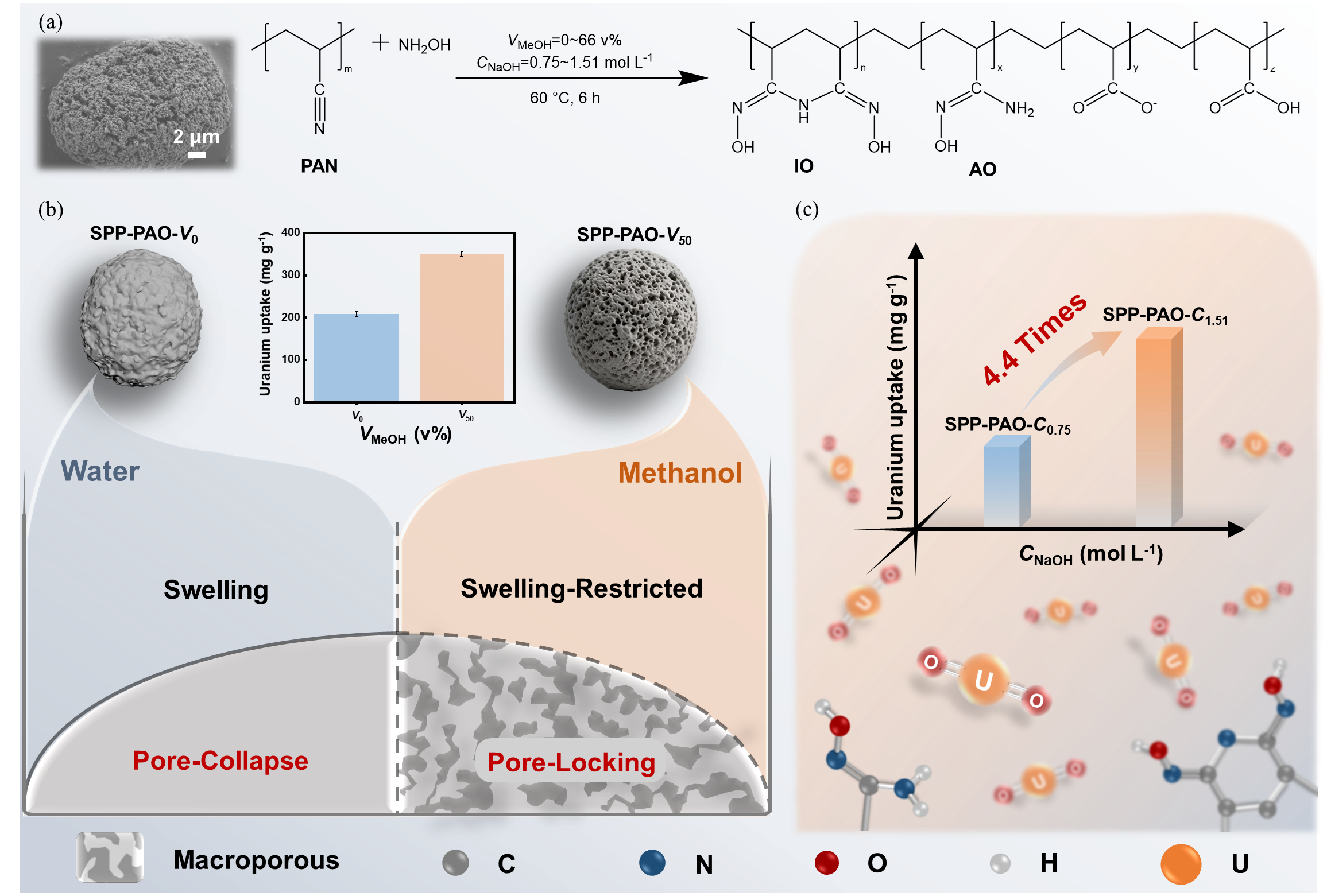
  • 1 Macroporous Polyamidoxime Particles with Tunable Cyclization Functionalization via a Swelling-Restricted Pore-Locking Preservation Strategy for Efficient Uranium Extraction from Seawater Published in Chemical Engineering Journal

    Doctoral student Junxiang Wu and colleagues in our team, under the joint supervision of Researcher Liangbin Li and Professor Yanan Ye, focused on key challenges associated with polyamidoxime-based adsorbents for uranium extraction from seawater, including low mass-transfer efficiency and poor uranium/vanadium selectivity. By combining a swelling-restricted pore-locking strategy with regulation of the cyclic imide dioxime content, the team achieved orthogonal control over the physical structure and chemical properties of polyamidoxime and developed macroporous polyamidoxime particles (SPP-PAO) with a tunable proportion of cyclic imide dioxime functional groups. This approach effectively alleviated problems commonly encountered during the modification of conventional polyamidoxime adsorbents, including pore collapse, insufficient uranium/vanadium selectivity, and low mass-transfer efficiency, providing a new materials-design strategy for the scale-up of uranium extraction from seawater. The related work was published in Chemical Engineering Journal.

    In this study, the team employed commercial polyacrylonitrile (PAN) as the precursor and prepared SPP-PAO adsorbents through amidoximation in a water–methanol cosolvent system. Methanol was used as a poor solvent to restrict swelling of the polymer chains, thereby preserving the macroporous structure. Meanwhile, precise regulation of the concentrations of open-chain amidoxime (AO) and cyclic imide dioxime (IO) groups was achieved by adjusting the alkali concentration. The study systematically revealed the structure–property relationships between pore structure and adsorption performance, as well as between functional-group composition and uranium selectivity. After five consecutive adsorption–desorption cycles, the adsorption-capacity retention remained at or above 80%. Using 0.5 M hydrochloric acid as the desorption solution, more than 95% elution efficiency was achieved within 10 min. More importantly, the material was successfully scaled up to the kilogram level, with a single batch in a 50 L reactor yielding 4.4 kg of product. Four parallel batches all exhibited adsorption capacities exceeding 300 mg g−1 in a uranium solution with a concentration of 4 mg L−1, while the unit production cost was only 13.55 USD kg−1. Based on these results, the proposed strategy combining swelling-restricted pore locking with orthogonal regulation of cyclized functional groups enables the resulting SPP-PAO adsorbent to simultaneously exhibit a macroporous structure, rapid mass transfer, high uranium/vanadium selectivity, and good cycling stability.

    This work establishes an orthogonal regulatory relationship between macroporous structure and the proportion of cyclized functional groups, and systematically investigates the synergistic relationships between pore structure and adsorption kinetics, as well as between functional-group composition and selectivity, in polyamidoxime-based adsorbents. The findings provide experimental evidence and a technical route for the development of scalable, low-cost, and highly selective materials for uranium extraction from seawater.

    This work was supported by the National Natural Science Foundation of China (52303028), the Institutionalized Platform Project (JZHKYPT-2021-04), and the Innovation and Development Fund of the China Uranium Extraction from Seawater Technology Innovation Alliance (No. CNNC-HSTY-2024-003 and No. CNNC-CXLM-202207).

    Wu, J.; He, Y.; Zhang, X.; Mo, H.; Wang, Y. N.; Chen, S.; Song, Z.; Ye, Y. N.; Li, L. Macroporous polyamidoxime particles with tunable cyclization functionalization via a swelling-restricted pore-locking preservation strategy for efficient uranium extraction from seawater. Chemical Engineering Journal 2026, 542, 178224.

    Paper Link: https://doi.org/10.1016/j.cej.2026.178224


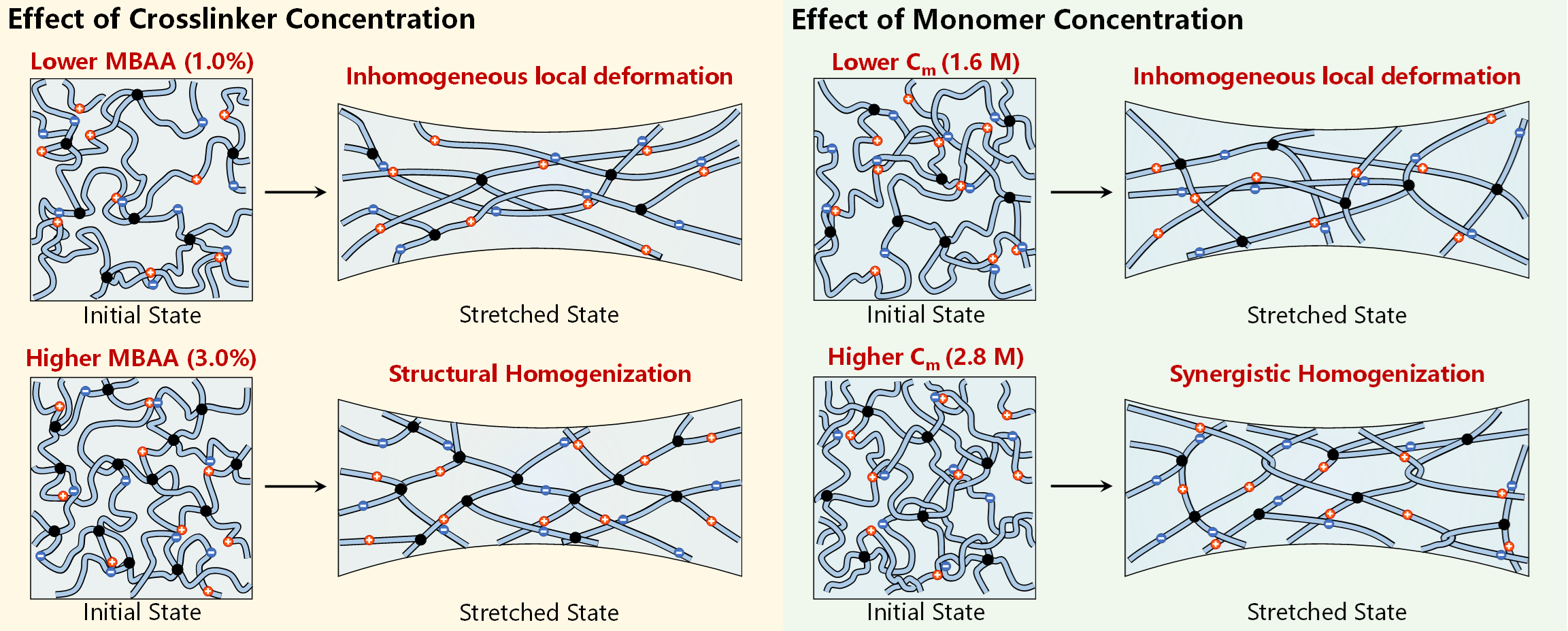
  • 2 Chain Network Deformation of Tough and Self-Healing Polyampholyte Gels Revealed by Small-Angle Neutron Scattering Published in Polymer Journal

    Doctoral student Kaining He and colleagues in our team, under the supervision of Professor Kunpeng Cui, investigated the chain-network deformation behavior of tough and self-healing polyampholyte hydrogels under uniaxial stretching using small-angle neutron scattering. The related work was published in Polymer Journal.

    In this work, we focused on polyampholyte (PA) hydrogels constructed through the combined effects of ionic bonds and chemical crosslinks, with particular attention to the approximately 10 nm chain-network length scale that has remained insufficiently explored within their multiscale structures. Previous studies have mainly focused on the dissociation of ionic bonds and the evolution of phase structures, whereas how the chain network deforms during stretching has remained unclear. To obtain sufficient scattering contrast, the water in the gels was replaced with heavy water. Small-angle neutron scattering (SANS) measurements were then performed on gels under uniaxial stretching using the Very Small Angle Neutron Scattering instrument at Beam Line 14 (BL-14) of the China Spallation Neutron Source. A fixed-strain relaxation protocol was adopted so that the ionic bonds could sufficiently relax toward a quasi-equilibrium state before measurement, thereby enabling direct characterization of the deformation of the permanent topological network formed by chemical crosslinks and physical entanglements.

    By systematically varying the concentration of the crosslinker MBAA from 1.0% to 3.0% and the monomer concentration from 1.6 M to 2.8 M, and by using the Porod–Lorentzian model to extract the correlation length ξ and the Porod exponent m, we compared the microscopic chain-network strain with the macroscopic affine prediction and introduced a nonaffine deviation parameter, Δ, to quantitatively describe the difference between them. The results showed that the system with a relatively low crosslinker concentration of 1.0% MBAA exhibited no phase separation but contained local structural inhomogeneities. During stretching, these microdomains underwent nonuniform local deformation that deviated significantly from the affine prediction. As the crosslinker concentration increased, permanent crosslinks divided the network into shorter and more uniform chain segments, suppressing local inhomogeneous deformation and driving the chain-network deformation toward affine behavior. Increasing the monomer concentration introduced more physical entanglements and produced a similar homogenizing effect.

    Furthermore, by using Δ as a quantitative indicator of network structural uniformity and correlating it with the elongation at break, we found that the relationship between structural uniformity and extensibility in PA gels is opposite to that observed in conventional chemical gels: the more structurally inhomogeneous the network, the greater the elongation at break. This behavior arises because dynamic ionic bonds progressively dissociate during deformation and dissipate energy, thereby accommodating strain mismatch among different microscopic regions and delaying fracture. In contrast to the conventional understanding established for chemically crosslinked gels such as Tetra-PEG gels, in which greater structural uniformity is generally associated with improved mechanical performance, this work completes the deformation picture of PA gels at the approximately 10 nm chain-network scale. The results demonstrate that the structure–property relationships of gels containing dynamic bonds cannot be directly inferred from permanently crosslinked systems, providing new insights into the understanding and design of tough and self-healing hydrogels.

    This work was supported by the National Natural Science Foundation of China (52273028 and U2430213). The SANS experiments were carried out at Beam Line 14 of the China Spallation Neutron Source under its user program (Proposal No. P1424121700012).

    He, K.; Huang, S.; Li, Y.; Cui, K. Chain network deformation of tough and self-healing polyampholyte gels revealed by small-angle neutron scattering. Polymer Journal 2026.

    Paper Link: https://doi.org/10.1038/s41428-026-01228-8


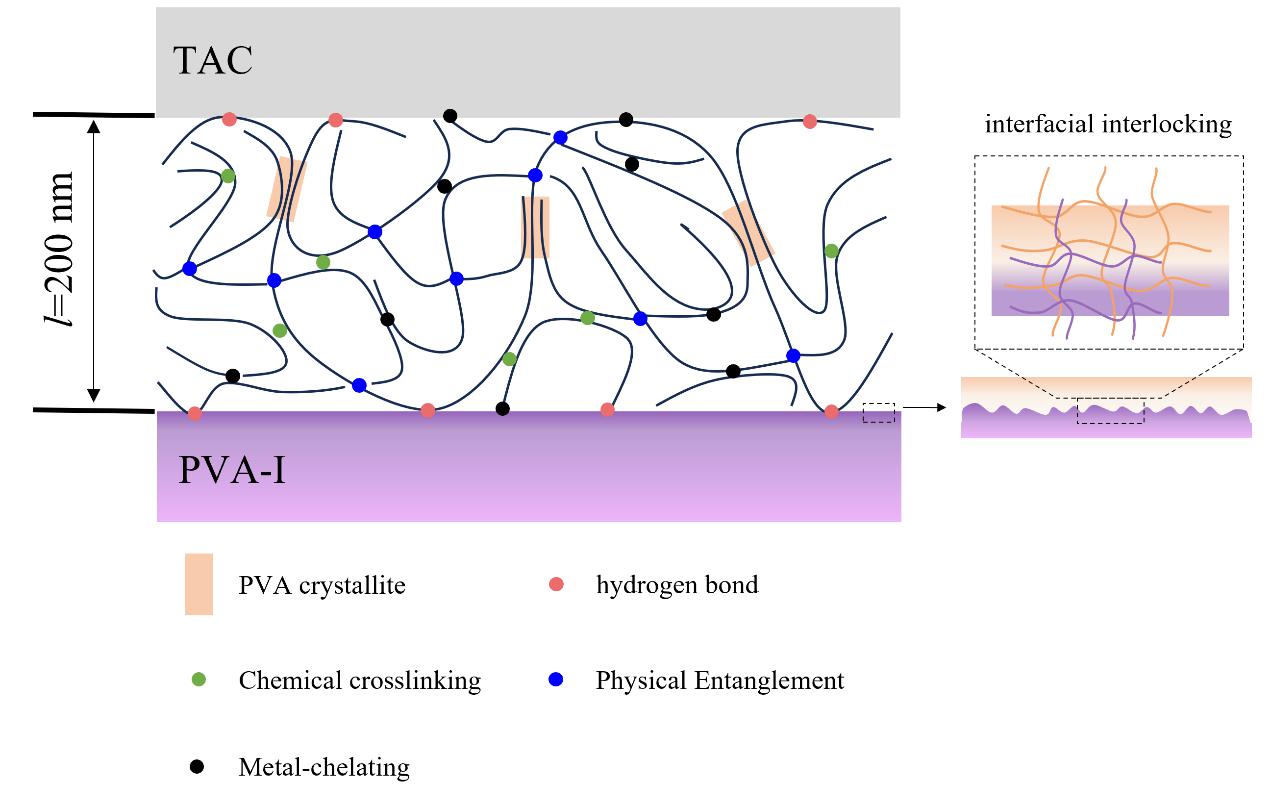
  • 3 Tuning the Multinetwork Structures of Acetoacetylated Poly(vinyl alcohol) Adhesives for Polarizers with Zn²⁺: Achieving Synergistic Improvements in Cohesion and Interfacial Bonding Published in Langmuir

    Doctoral student Jun Chen and colleagues in our team, under the supervision of Professor Wei Chen, investigated the structural regulation and performance optimization of waterborne PVA adhesives for polarizers. The related work was published in Langmuir. By introducing Zn2+ coordination into an acetoacetylated poly(vinyl alcohol) (AAPVA) system, the study constructed a synergistic multinetwork structure that effectively enhanced interfacial adhesion, cohesive strength, and hydrothermal resistance of the adhesive.

    The results showed that, under optimized conditions, the average peel strength of the adhesive increased from 2.68 × 10⁻² N·mm−1 to 9.32 × 10⁻² N·mm−1, while excellent stability under hydrothermal aging was also achieved. This work provides a new strategy for the design of high-performance waterborne adhesives for polarizers.

    This work was supported by the National Natural Science Foundation of China (52422302) and the Natural Science Foundation of Anhui Province (2308085UM02 and 2408055UM001).

    Chen, J.; Chen, X.; Wu, L.; Cheng, H.; Chen, J.; Chen, W. Tuning the Multinetwork Structures of Acetoacetylated Poly(vinyl alcohol) Adhesives for Polarizers with Zn2+: Achieving Synergistic Improvements in Cohesion and Interfacial Bonding. Langmuir 2026, 42(25), 18217–18228.

    Paper Link: https://doi.org/10.1021/acs.langmuir.6c01836


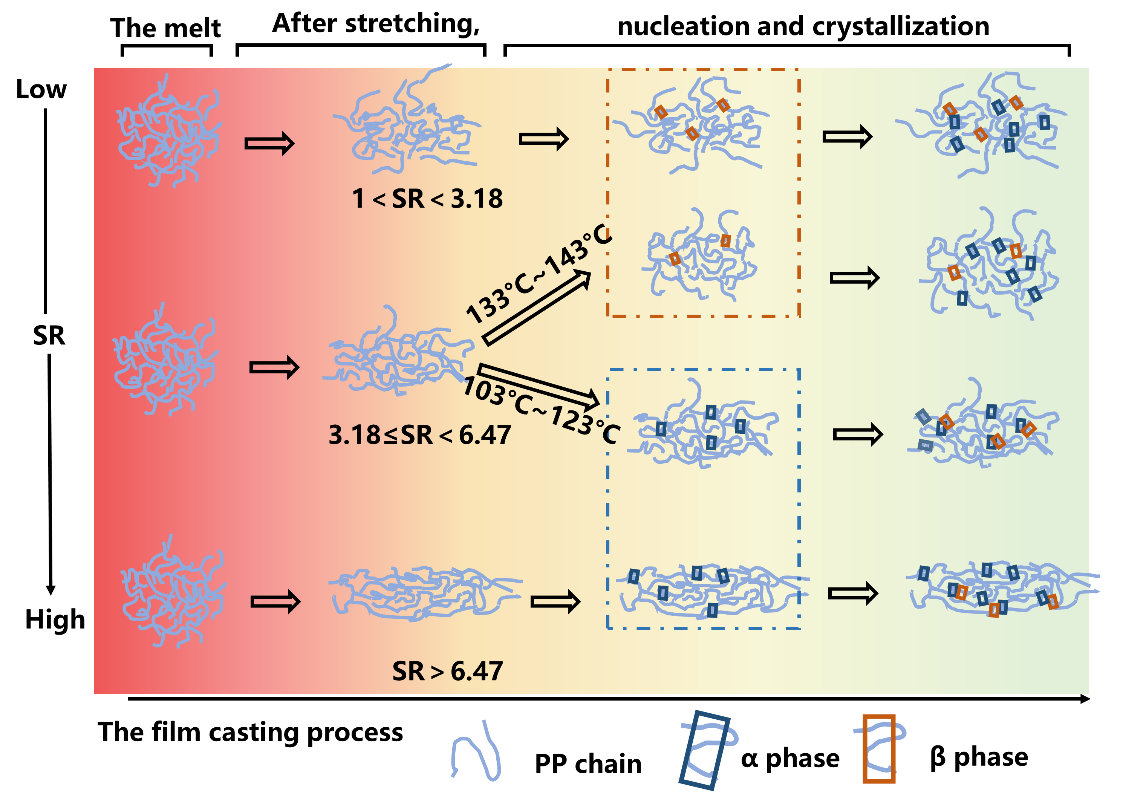
  • 4 Competition of Nucleation and Growth between α- and β-Crystals during Industrial-Scale Isotactic Polypropylene Film Casting Revealed by Synchrotron Radiation X-ray Scattering Published in Macromolecules

    Doctoral student Yu Luo and colleagues in our team, under the joint supervision of Researcher Liangbin Li, Professor Fengmei Su, and Professor Kunpeng Cui, investigated the challenges of α/β crystal-form selection and microstructure regulation during industrial-scale isotactic polypropylene (iPP) film casting. By combining a custom-built industrial-scale steel-belt in situ casting apparatus with high-time-resolution synchrotron X-ray scattering, the team directly observed, under realistic industrial casting conditions, the preferential direct nucleation of the metastable β-phase without epitaxial growth on α-crystal templates. The study revealed the coupled effects of stretching ratio (SR), belt temperature (Tbelt), and the through-thickness temperature gradient (Tgra) in governing the competitive nucleation and growth of α- and β-crystals, providing new mechanistic insights and research strategies for precise crystal-form control and performance enhancement of industrial polypropylene films. The related work was published in Macromolecules.

    In this study, the team integrated a custom-built steel-belt casting apparatus with synchrotron wide-angle X-ray scattering (WAXS), enabling in situ monitoring of microstructural evolution from the extruded melt to the fully solidified film while independently controlling SR and Tbelt. By systematically varying SR from 1.398 to 29.5 and Tbelt from 103 to 143 °C, the team obtained detailed information on the microscopic evolution of the crystalline structure in polypropylene cast films and observed that the metastable β-phase could nucleate earlier than the α-phase. Combined temperature simulations and experiments showed that within a processing window characterized by low SR (1.398–3.18), temperatures of 100–140 °C, and a moderate temperature gradient of Tgra ≤ 225 °C/mm, the β(300) diffraction peak appeared before the α(110)/α(040) peaks. This result demonstrates that the β-phase can nucleate directly and preferentially without relying on epitaxial growth on α-crystal templates. Increasing SR progressively favored α-phase nucleation, whereas increasing Tbelt promoted β-phase formation up to 133 °C. The total crystallinity remained approximately 65%, while the α/β ratio changed systematically. FTIR mapping further confirmed that the β-phase content on the side of the film adjacent to the steel belt was significantly higher than that at the upper surface. Based on these observations, the team established a processing-window map describing the competitive nucleation and growth of α- and β-crystals during industrial film casting and quantitatively constructed relationships among SR, Tbelt, Tgra, and the final crystalline-phase composition.

    This work revealed the direct preferential nucleation of β-crystals under industrial-scale casting conditions, demonstrating that β-phase formation does not necessarily require epitaxial growth on α-crystal templates. The findings further highlight the importance of realistic processing conditions for uncovering previously unresolved crystallization pathways. The mechanistic framework established in this study can be used to optimize the crystalline structure and microstructure of iPP cast films through regulation of stretching ratio, belt temperature, and temperature gradient, providing experimental evidence and new research strategies for structural control and industrial manufacturing of high-performance polymer films.

    This work was supported by the National Natural Science Foundation of China (U2430213) and a project of the Chinese Academy of Sciences (JZHKY-PY-2021-04). The authors also acknowledge the support of the BL10U1 beamline at the Shanghai Synchrotron Radiation Facility.

    Luo, Y.; Cheng, S.; Liu, S.; Wei, X.; Zhu, J.; Li, L.; Su, F.; Cui, K. Competition of Nucleation and Growth between α- and β-Crystals during Industrial-Scale Isotactic Polypropylene Film Casting Revealed by Synchrotron Radiation X-ray Scattering. Macromolecules 2026, 59(12), 6786–6799.

    Paper Link: https://doi.org/10.1021/acs.macromol.6c01070


  • 5 Dopamine-Coated LTO Particles Immobilized in PVA with Directional Dendritic Channels for Fast and Selective Lithium Capture from Salt-Lake Brines Published in Desalination


    Doctoral student Xunshuang Zhang and co-workers from our team, under the joint supervision of Researcher Liangbin Li and Professor Yanan Ye, focused on key technologies for efficient and selective lithium extraction from salt-lake brines. By integrating directional freeze casting with dopamine-mediated interfacial modification, they developed, for the first time, an LTO@PDA/PVA composite adsorbent featuring directional dendritic through-channels. This design successfully addresses engineering bottlenecks associated with conventional powdered lithium-ion sieves, including particle aggregation, slow masstransfer, difficult recovery, and poor cycling stability, providing a new material strategy and design principle for lithium extraction from complex salt-lake systems. The related research results have been published in Desalination.

    In this study, the team uniformly immobilized dopamine-coated lithium metatitanate particles (LTO@PDA) within a PVA matrix and constructed continuous dendritic ion-transport channels through directional freeze casting. The structure–performance–mass transfer relationship was systematically elucidated. Experimental results showed that dopamine modification significantly improved the dispersibility and hydrophilicity of LTO, suppressed particle aggregation, and fully exposed lithium-exchange sites. Meanwhile, the directional dendritic channels greatly shortened ion-diffusion pathways and substantially enhanced mass-transfer efficiency, enabling rapid lithium-ion adsorption. In simulated Qarhan salt-lake brine, the adsorbent exhibited consistent performance advantages: the lithium adsorption capacity reached 25.47 mg·g⁻¹ within 24 h, and the separation factors for Na⁺, K⁺, Ca²⁺, and Mg²⁺ reached up to 822.78, demonstrating excellent anti-interference selectivity.

    Despite differences in initial structure and ionic environment, the team identified a common rule: directional dendritic channels can simultaneously improve adsorption kinetics and cycling stability. After 30 consecutive adsorption–desorption cycles, the adsorbent retained no less than 86.7% of its adsorption capacity, while the titanium dissolution rate was as low as 0.3% per cycle. XPS characterization confirmed that Li⁺ adsorption mainly proceeds through Li⁺/H⁺ ion exchange. The dopamine layer assists mass transfer and dispersion through electrostatic interactions but does not participate in the core chemical adsorption process. Based on these key findings, the team proposed an efficient lithium-extraction material design strategy that combines directional dendritic channels with dopamine-mediated interfacial modification. The resulting LTO@PDA/PVA adsorbent integrates high mechanical strength, rapid mass transfer, high selectivity, and long cycling life, making it directly compatible with engineering applications for lithium extraction from salt-lake brines.

    This work is the first to introduce a directional dendritic structure into the shaping design of lithium adsorbents. It establishes a quantitative correlation between ion-transport channel structure and lithium-extraction performance, deepens the understanding of the structure–mass transfer–selectivity synergy in polymer composite lithium-ion sieves, and provides key experimental evidence and a technical route for developing engineerable, long-life, and highly selective materials for lithium extraction from salt-lake brines.

    This work was supported by the National Natural Science Foundation of China (52303028), the Institutional Platform Project (JZHKYPT-2021-04), and the Innovation Development Fund of the China Innovation Alliance of Uranium Extraction from Seawater (Nos. CNNC-HSTY-2024-003 and CNNC-CXLM-202207).

    Xunshuang Zhang, Yiming Hua, Mengyu Xie, et al. Dopamine-coated LTO particles immobilized in PVA with directional dendritic channels for fast and selective lithium capture from salt-lake brines[J].Desalination,2026: 120225.

    Paper Link: https://doi.org/10.1016/j.desal.2026.120225


  • 6 Multiaxial Stress Relaxation of Dually Crosslinked Tough Polyampholyte Gel Published in Macromolecules


    Doctoral student Kaining He and colleagues in our team, under the joint supervision of Professor Kunpeng Cui and Professor Xueyu Li, systematically investigated the stress relaxation mechanism of dually crosslinked tough polyampholyte hydrogels under multiaxial deformation modes. The related work was published in Macromolecules.

    In this work, we systematically examined the stress relaxation behavior of polyampholyte (PA) hydrogels containing both chemical crosslinks and strong ionic-bond physical crosslinks under uniaxial, planar, and equibiaxial deformation modes. Using a biaxial stretching apparatus independently developed in our laboratory, we obtained extensive stress relaxation data under different deformation modes and introduced an accelerated rupture parameter, m, to quantitatively describe the strain-accelerated rupture process of ionic bonds.

    The study revealed that the rupture kinetics of ionic bonds exhibit damage anisotropy. During deformation, uniaxial stretching allows greater lateral contraction freedom of polymer chains, which more readily leads to pronounced local stress concentration and thus the fastest ionic bond rupture. In contrast, under equibiaxial stretching, the network is constrained in multiple directions, which relatively alleviates such stress concentration and results in the slowest rupture. This trend was quantitatively described by the accelerated rupture parameter as m Uniaxial > m Planar > m Equibiaxial.

    Based on these findings, building upon our previous work on a uniaxial constitutive model, we further developed a transient network constitutive model applicable to multiaxial stretching. In this model, the total stress is decoupled into three contributions: the chemical network, the remaining physical bonds, and the reformed physical bonds. The fitted parameters enable prediction of the nonlinear relaxation process of the gel under complex multiaxial states.

    Different from previous studies that were mainly limited to uniaxial testing, this work systematically investigated stress relaxation behavior under multiaxial deformation modes and revealed the dissociation kinetics of strong physical crosslinks from the perspective of “damage anisotropy.” These findings provide new insights for the design of advanced soft materials, such as flexible actuators and artificial cartilage, intended for long-term service under complex loading conditions.

    This work was supported by the National Natural Science Foundation of China (52273028 and U2430213).

    He,K.; Huang, S.; Zhu, J.; Chu, Z.; Li, Y.; Li, L.; Li, X.; Cui, K.,Multiaxial stress relaxation of dually crosslinked tough polyampholyte gel. Macromolecules 2026, 59(9): 5325-5337.

    Paper Link: https://doi.org/10.1021/acs.macromol.6c00198


  • 7 Single-Sided NMR for Real-Time Tracking of Porous Structure Formation of Acrylate Copolymer Waterproof Composites during Erosion Published in Analytical Chemistry


    Doctoral student Xiaojie Chen and colleagues from our team, under the joint supervision of Researcher Liangbin Li and Specially Appointed Professor Wei Chen, focused on the application of polyacrylate waterproof composite materials in the field of waterproof coatings. Under harsh service environments such as acid rain, the dynamic evolution of the internal structure of these materials has long been a challenging issue for detection in this field. Our team further developed an in situ characterization technique based on Single-Sided Nuclear Magnetic Resonance (Single-Sided NMR). Taking advantage of its spatial resolution, and in collaboration with BASF Advanced Chemicals Co., Ltd. (Shanghai), we carried out a systematic study on the failure mechanism of waterproof coatings and achieved in situ detection of the erosion process under acidic conditions. The related research findings were published in the journal Analytical Chemistry.

    This work was supported by BASF Advanced Chemicals Co., Ltd. Shanghai, the National Natural Science Foundation of China (52422302), and the Natural Science Foundation of Anhui Province (2308085UM02, 2208085UM01, 2208085UM04, and 2408055UM001).

    Xiaojie Chen, Lingxun Qi, Jun Chen, Lei Wu, Linghan Shi, Zhong Zeng, YiqunYang, Zhengnan Yang, Jie Sun, Wei Chen, Single-Sided NMR for Real-Time Tracking of Porous Structure Formation of Acrylate Copolymer Waterproof Composites during Erosion, Analytical Chemistry, 2026, 98(11), 8060−8069.

    Paper Link: https://doi.org/10.1021/acs.analchem.5c05550

  • 8 Quantitative Correlation between Mechanical Behaviors and Free Volume of Oriented Polyethylene Terephthalate: an In Situ PALS Study Published in Macromolecules


    Doctoral student Zhang Yuwenya and colleagues, under the joint supervision of Researcher Li Liangbin, Researcher Zhang Hongjun, and Postdoctoral Fellow Chen Jungen, focused on the microscopic structural evolution mechanisms of semicrystalline polymer materials. Using a self-developed positron annihilation lifetime spectroscopy technique, the team achieved, for the first time, in situ real-time measurement of the free volume in the amorphous regions of oriented polyethylene terephthalate (PET) films during tensile deformation. They further proposed the innovative concept of “free volume modulus,” providing a new approach for establishing a quantitative relationship between microscopic structure and macroscopic mechanical properties. The related research findings have been published in Macromolecules.

    In this study, the research team precisely regulated the initial structure of the samples through annealing treatments at different temperatures, and systematically revealed the evolution of free volume at different stages of deformation. The experiments showed that, in the linear region of tensile deformation, the response mechanism of free volume is closely related to the initial structure: samples annealed at lower temperatures, with less free volume, mainly exhibited enlargement of existing holes, whereas samples annealed at higher temperatures, with more free volume, mainly exhibited the generation of new holes. Despite these different pathways, the team identified a common pattern: regardless of the initial structure, the relative increase in the relative free volume fraction of the amorphous regions showed a highly consistent linear relationship with stress, with slopes stabilizing at approximately 1.3/GPa in the elastic region and 4.0/GPa in the plastic region.

    Based on this significant finding, the team proposed the new concept of free volume modulus (Kf) to quantitatively describe the relationship between changes in stress-field intensity and changes in free-volume hole volume. In PET, the work measured Kf values of approximately 0.77 GPa in the elastic region and 0.25 GPa in the plastic region. The study also found that the modulus of the amorphous regions (Eam) is negatively correlated with hole number density, while showing little correlation with hole size, indicating that the key factor determining stiffness is the number of highly mobile chain segments surrounding the holes.

    This work establishes, for the first time in PET, a quantitative linear relationship between stress and free volume fraction, and proposes the new parameter of free volume modulus. It deepens the understanding of the deformation mechanisms of semicrystalline polymers and provides crucial experimental evidence and theoretical insight for the future development of quantitative constitutive models that take microscopic structural evolution into account.

    This work was supported by the Chinese Academy of Sciences (JZHKYPT-2021-04) and the National Natural Science Foundation of China (52303048, 12275270).


    Zhang Y, Liu L, Kang W,et al.Quantitative Correlation between Mechanical Behaviors and Free Volume of Oriented Polyethylene Terephthalate: an In-Situ PALS Study. Macromolecules 2026,59,6, 3789–3799.

    Paper Link: https://pubs.acs.org/doi/10.1021/acs.macromol.5c03108.


  • 9 Temperature-Cycling-Guided Self-Assembly of DNA-Functionalized Nanoparticles for Avoiding Kinetic Traps Published in Nano Letters

    Dr. Yunhan Zhang from our team, under the guidance of Professor Liangbin Li's research team, proposed a temperature-cycling-guided self-assembly strategy to avoid kinetic traps in the self-assembly of DNA-functionalized gold nanoparticles and enable the formation of defect-free crystals. The self-assembly of DNA-functionalized gold nanoparticles (DNA-AuNPs) holds great potential for constructing ordered nanostructures. However, when interparticle interactions are excessively strong, the system can readily become trapped in long-lived disordered aggregate states, known as “kinetic traps,” leading to numerous crystal defects that severely compromise functionality. Conventional thermal annealing is often limited by free-energy barriers and therefore cannot completely eliminate these metastable defects. Developing an effective strategy that can guide the system out of kinetic traps and achieve defect-free assembly has thus become a key challenge in this field. The proposed strategy periodically alternates between high and low temperatures (Thigh/Tlow), thereby reversibly regulating hydrogen-bond interactions between DNA strands. During the high-temperature stage, thermal energy helps particles escape metastable and misbound states and enhances their ability to undergo local rearrangement; during the low-temperature stage, hydrogen bonds reform and defects are repaired, driving the system toward a more stable energetic state. By combining theoretical modeling, coarse-grained molecular dynamics simulations, and experimental validation, the team demonstrated that this strategy provides sustained and periodic energy input, exploits cooperative interparticle effects to perturb defective regions, and guides the system across free-energy barriers, ultimately enabling the efficient formation of defect-free body-centered cubic (BCC) crystals.
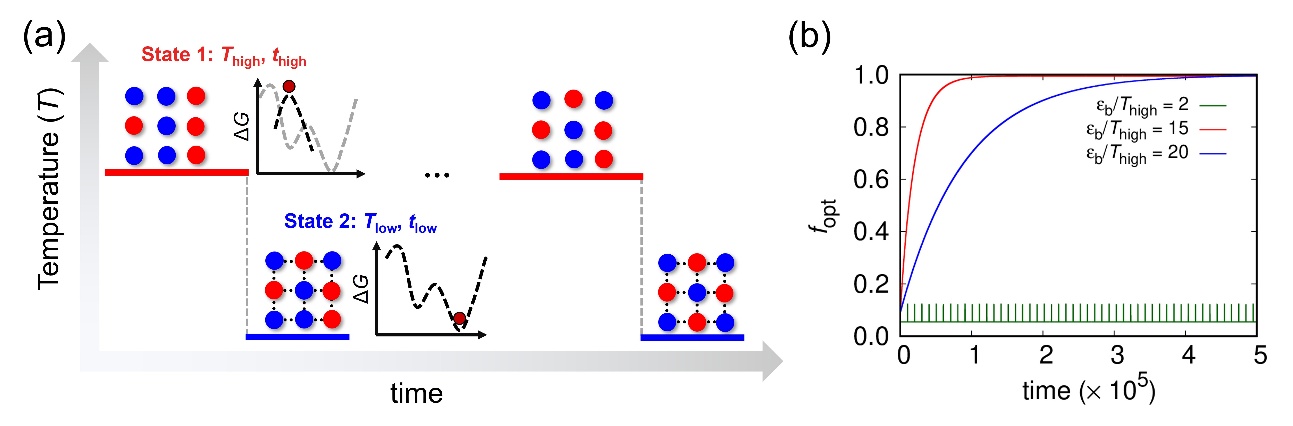
    Figure 1. (a) Schematic free-energy landscape of temperature-cycling-guided self-assembly; (b) assembly yield as a function of time predicted by the theoretical model.

    Simulation and experimental results showed that when the temperature of the high-temperature stage was set near the melting point of the system (e.g., Thigh ≈ 0.29–0.41) and maintained for an appropriate duration, nearly perfect single crystals could be obtained. In contrast, constant low temperatures and excessively high temperatures led to kinetic trapping and particle dispersion, respectively. Analysis of crystal orientation using the polyhedral template matching (PTM) method showed that temperature cycling effectively eliminated the coexistence of multiple crystallites and produced a single crystallographic orientation. Furthermore, in nucleotide-level simulations, the strategy successfully guided DNA-AuNPs from a disordered state into a defect-free BCC structure, further validating its effectiveness at the molecular scale.
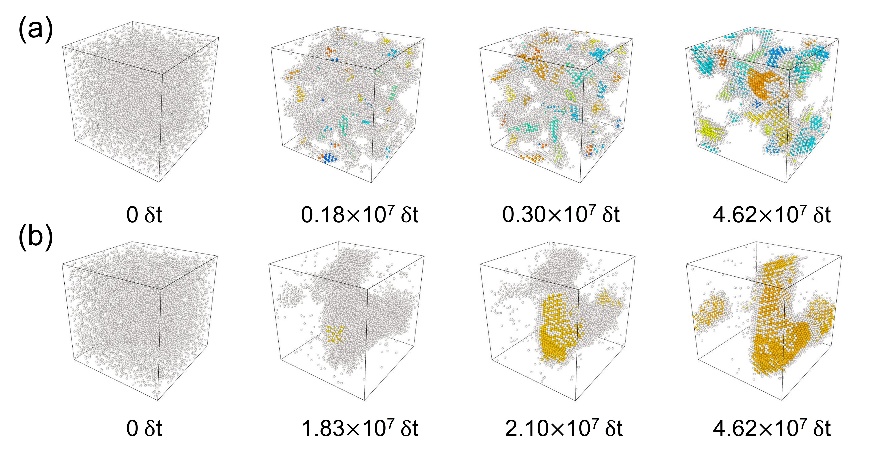
    Figure 2. Crystallization process of the DNA-AuNP system under fixed conditions of thigh = 1.2 × 10⁵δt, Tlow = 0.1, and tlow = 3.0 × 10⁴δt. Starting from a disordered initial state, the crystallization behaviors at (a) Thigh = 0.20 and (b) Thigh = 0.31 are shown. Particles are colored according to their structural types identified by PTM, with different colors representing different crystallographic orientations. Free and unclassified particles are shown in gray.

    This work elucidates the nonequilibrium kinetic mechanism underlying temperature-cycling-driven self-assembly of DNA-AuNPs and overcomes the limitations of conventional thermal annealing in eliminating kinetic traps. The proposed periodic energy-injection strategy is applicable not only to DNA-functionalized nanoparticle systems but also, in principle, to other self-assembly systems hindered by kinetic traps. Its underlying physical principle—periodically modulating interparticle interactions through an external field to guide assembly—may be extended to systems such as block copolymer thin films. This approach provides a new strategy for constructing defect-free functional nanomaterials.

    This work was supported by the National Natural Science Foundation of China (22503090), the Fundamental Research Funds for the Central Universities (WK2310000119), and the China Postdoctoral Science Foundation (2023M743377).

    Zhang, Y.; Cao, R.; Sun, H.; Xu, T.; Li, L. Temperature-Cycling-Guided Self-Assembly of DNA-Functionalized Nanoparticles for Avoiding Kinetic Traps. Nano Letters 2026, 26(10), 3589–3595.

    Paper Link: https://pubs.acs.org/doi/10.1021/acs.nanolett.6c00253



  • 10 Janus Optical Clear Adhesive with Tunable Crosslinking Density Gradient for Foldable Display Published in Polymer


    Recently, our team, under the guidance of Professor Wei Chen, conducted research on the structural design and performance regulation of optical transparent pressure-sensitive adhesives (OCA) for foldable displays. A new strategy was proposed for a dual-layer Janus OCA with a crosslinking density gradient. This work, led by master's student Jiaying Deng and others, addresses issues in traditional OCAs, such as screen creases, interface failure, and uneven stress distribution during repeated folding. By constructing an asymmetric structure with a low crosslinking density layer—high crosslinking density layer along the thickness direction, a balance was achieved between interfacial adhesion and internal cohesion. The research shows that this dual-layer design not only maintains excellent optical performance but also significantly improves the material's mechanical response and folding reliability, providing a new approach for the design of key adhesive layers in next-generation flexible and foldable display devices.

    In this study, three types of single-layer OCAs and their corresponding dual-layer structures were systematically developed. The network structure was quantitatively characterized using low-field nuclear magnetic resonance (LF-NMR), double-quantum nuclear magnetic resonance (DQ-NMR), and single-side nuclear magnetic resonance (UNMR). Among them, UNMR, with a spatial resolution of 10 μm, directly verified the crosslinking density gradient along the thickness direction of the dual-layer adhesive film. Performance tests showed that all OCA samples had a transmittance higher than 95% and a haze lower than 0.6% within the visible light range, meeting the requirements for optical transparent adhesives in display applications. Compared to single-layer high-crosslink samples, the dual-layer Janus OCA exhibited better creep recovery ability while maintaining a high peel strength, and it demonstrated superior durability in both static and dynamic folding tests. Notably, when the dual-layer adhesive film M62 was attached to ITO on the low crosslinking density side, it showed the best dynamic folding stability, indicating that this asymmetric gradient structure could more effectively distribute stress, suppress cracks, and prevent interface delamination, thus enhancing the service reliability of foldable display devices.

    This research, starting from the polymer network structure, reveals the role of crosslinking density as a key structural parameter in modulating modulus, viscoelastic response, deformation ability, and stress redistribution during the folding process. It also proves the application potential of Janus gradient design in the development of high-performance OCAs. The results provide experimental evidence and theoretical references for the precise design and performance optimization of optical transparent pressure-sensitive adhesives in the field of flexible displays.

    This research was supported by the National Natural Science Foundation of China (52422302), the Anhui Provincial Natural Science Foundation (2408055UM001, 2308085UM02, 2208085UM01, 2208085UM04), and the Chinese Academy of Sciences (JZHKYPT-2021-04).

    Jiaying Deng, Lei Wu, Xiaojie Chen, Lingxun Qi, Haotian Wu, Jie Chen, Sarah Palloks, and Wei Chen*.Janus optical clear adhesive with tunable crosslinking density gradient for foldable display[J].Polymer, 2026, 351: 129841.

    Paper Link:https://doi.org/10.1016/j.polymer.2026.129841


  • 11 Benzoate-Substituted Cellulose Films with Tunable Birefringence and Anomalous Optical Anisotropy Published in ACS Applied Polymer Materials


    Recently, under the joint supervision of Prof. Liangbin Li and Research Prof. Xueyu Li, doctoral student Wenhao Guo and other team members focused on the application of cellulose-based sustainable optical films in novel display technologies, specifically investigating the homogeneous synthesis and stretching orientation mechanisms of cellulose benzoate films. Through systematic characterization and macroscopic optical property testing, the team revealed the structure-processing-property relationship governed by the competitive orientation between the cellulose main chain and bulky side groups. This provides scientific guidance for the design and manufacturing of high-performance bio-based optical compensation films. The related work was published in the journal ACS Applied Polymer Materials.

    In this work, the preparation process and structural characteristics of optical compensation films—a critical core material in novel display technologies such as liquid crystal displays (LCDs) and organic light-emitting diodes (OLEDs)—were explored in depth. As an essential component of wide-color-gamut display panels, optical compensation films currently rely heavily on petroleum-based materials, while conventional bio-based alternatives (such as cellulose triacetate) face the challenge of a restricted birefringence tuning window. To overcome this material limitation, the fundamental scientific issues of cellulose benzoate (CBz) with precise degrees of substitution during processing were investigated in detail to analyze and establish the relationship between macroscopic properties and microscopic structures. This involved utilizing a homogeneous ionic liquid platform to synthesize materials with varying degrees of substitution, followed by uniaxial stretching. The team discovered a non-monotonic V-shaped dependence of birefringence on the degree of substitution, elucidated the steric hindrance-driven side-group orientation inversion mechanism, and successfully achieved precise tailoring of the films' three-dimensional refractive indices (encompassing zero birefringence, anomalous negative-to-zero characteristics, and positive C-plate behavior). This establishes a scientific foundation for the manufacturing of high-performance, eco-friendly optical compensation films.

    This research was jointly funded and supported by the Chinese Academy of Sciences Project (JZHKYPY-2021-04) and the LCD Polarizer Compensation Film Project.

    Wenhao Guo, Zhouhang Lei, Xingyue Fang, Zhengqi Tan, Xueyu Li*, and Liangbin Li*.Benzoate-Substituted Cellulose Films with Tunable Birefringence and Anomalous Optical Anisotropy[J].ACS Applied Polymer Materials, 2026.

    Paper Link: https://doi.org/10.1021/acsapm.5c04814


  • 12 Influence of Bulky Substituents on Optical Transparency and Dimensional Stability of Polyamide-imide Published in ACS Applied Polymer Materials


    Under the joint supervision of Professor Li Liangbin and Associate Researcher An Minfang, our team's doctoral student Guo Wenhao and colleagues focused on molecular structure design. By establishing structure-property relationships, they successfully developed a novel polyamide-imide (PAI) film that combines high optical transparency, excellent thermal stability, and a low coefficient of thermal expansion. This achievement provides an innovative solution to critical material challenges in flexible display technology and is expected to drive the rapid development of fields such as foldable smartphones and wearable electronics. The related work has been published in the journal ACS Applied Polymer Materials.

    In this work, a series of diamine monomers containing amide bonds and bulky substituents (such as methyl groups) were designed and copolymerized with 4,4'-(hexafluoroisopropylidene)diphthalic anhydride (6FDA) via a two-step polycondensation method to prepare novel poly(amide-imide) films. Experimental results demonstrate that the precise introduction of methyl substituents near the imide ring can significantly inhibit the formation of charge transfer complexes (CTC). Simultaneously, it increases the molecular chain spacing and reduces close packing through the steric hindrance effect. The optimized material (3-AMB-TFMB/6FDA) exhibits outstanding performance, featuring excellent optical properties (Ttot=89.0%,YI=0.73), thermal dimensional stability (CTE = 39.6 ppm·K⁻¹), and a high glass transition temperature (Tg=356 ℃). This research resolves the trade-off between optical transparency and thermal stability through molecular design, providing key material support for the development of large-size foldable screens and advanced human-machine interfaces.

    This work was supported by the Major Science and Technology Project of Hefei City, Anhui Province under the Open Competition Mechanism (Grant No. 2022-SZD-005), the Hefei Major Special Directed and Commissioned Project Research and Development of Polyvinyl Butyral (PVB) Film for Automotive Safety Glass, the Hefei Natural Science Foundation (Grant No. 202311), and the Chinese Academy of Sciences (Grant No. JZHKYPT-2021-04).


    Guo W, Han X, Tan Z, et al. Influence of Bulky Substituents on Optical Transparency and Dimensional Stability of Polyamide-imide[J]. ACS Applied Polymer Materials, 2025.

    Paper Link: https://pubs.acs.org/doi/full/10.1021/acsapm.5c00598


  • 每页 14 记录  总共 12 记录 
  • 第一页 <<上一页 下一页>> 尾页
  • 页码 1/1 跳转到 
USTC Graduate Admissions Portal Institute of Advanced Technology NSRL CAS Instrument Sharing Platform SSRF User System XAS Params

联系我们

电话:0551-63602081

地址:Academic Building 2,High-tech Campus,USTC

邮编:230029

邮箱:zhangmin@iat.ustc.edu.cn

Copyright©2018-2026 Anhui Provincial Engineering Research Center for Advanced Functional Polymer Films