
Doctoral student Kaining He and colleagues in our team, under the supervision of Professor Kunpeng Cui, investigated the chain-network deformation behavior of tough and self-healing polyampholyte hydrogels under uniaxial stretching using small-angle neutron scattering. The related work was published in Polymer Journal.
In this work, we focused on polyampholyte (PA) hydrogels constructed through the combined effects of ionic bonds and chemical crosslinks, with particular attention to the approximately 10 nm chain-network length scale that has remained insufficiently explored within their multiscale structures. Previous studies have mainly focused on the dissociation of ionic bonds and the evolution of phase structures, whereas how the chain network deforms during stretching has remained unclear. To obtain sufficient scattering contrast, the water in the gels was replaced with heavy water. Small-angle neutron scattering (SANS) measurements were then performed on gels under uniaxial stretching using the Very Small Angle Neutron Scattering instrument at Beam Line 14 (BL-14) of the China Spallation Neutron Source. A fixed-strain relaxation protocol was adopted so that the ionic bonds could sufficiently relax toward a quasi-equilibrium state before measurement, thereby enabling direct characterization of the deformation of the permanent topological network formed by chemical crosslinks and physical entanglements.
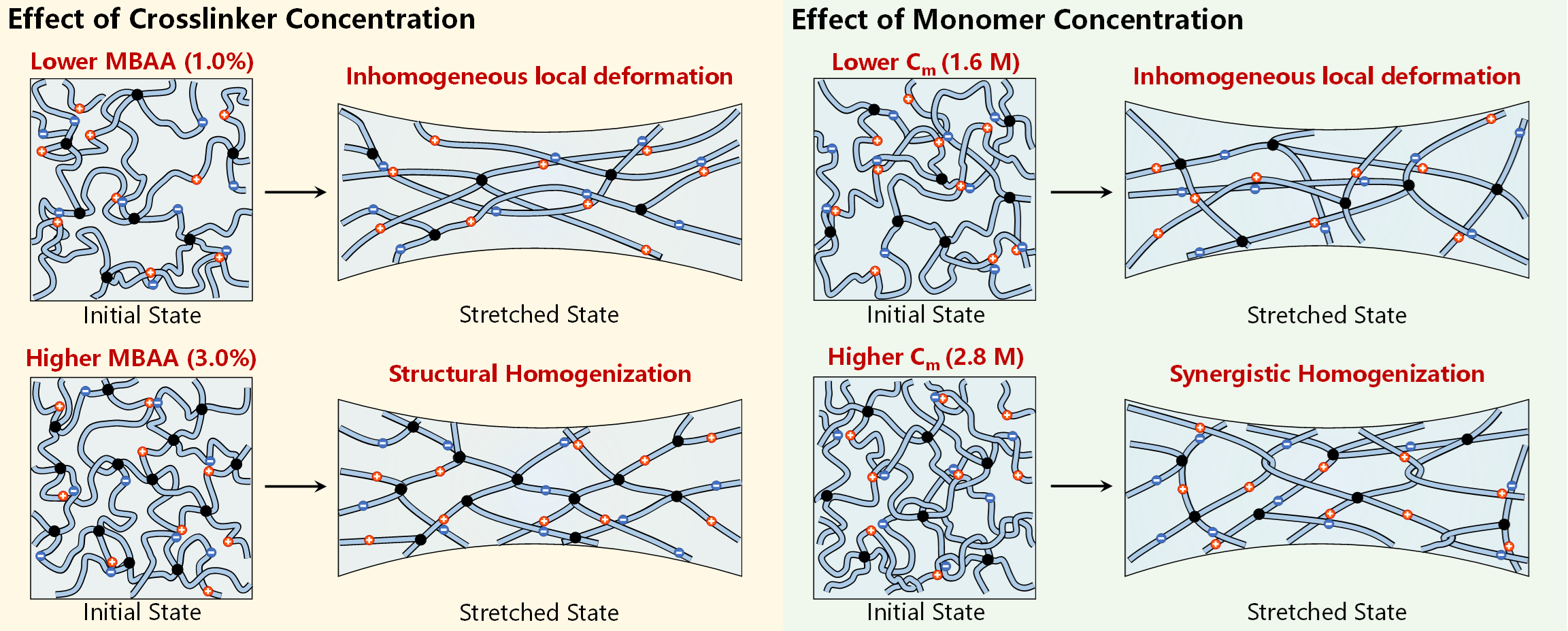
By systematically varying the concentration of the crosslinker MBAA from 1.0% to 3.0% and the monomer concentration from 1.6 M to 2.8 M, and by using the Porod–Lorentzian model to extract the correlation length ξ and the Porod exponent m, we compared the microscopic chain-network strain with the macroscopic affine prediction and introduced a nonaffine deviation parameter, Δ, to quantitatively describe the difference between them. The results showed that the system with a relatively low crosslinker concentration of 1.0% MBAA exhibited no phase separation but contained local structural inhomogeneities. During stretching, these microdomains underwent nonuniform local deformation that deviated significantly from the affine prediction. As the crosslinker concentration increased, permanent crosslinks divided the network into shorter and more uniform chain segments, suppressing local inhomogeneous deformation and driving the chain-network deformation toward affine behavior. Increasing the monomer concentration introduced more physical entanglements and produced a similar homogenizing effect.
Furthermore, by using Δ as a quantitative indicator of network structural uniformity and correlating it with the elongation at break, we found that the relationship between structural uniformity and extensibility in PA gels is opposite to that observed in conventional chemical gels: the more structurally inhomogeneous the network, the greater the elongation at break. This behavior arises because dynamic ionic bonds progressively dissociate during deformation and dissipate energy, thereby accommodating strain mismatch among different microscopic regions and delaying fracture. In contrast to the conventional understanding established for chemically crosslinked gels such as Tetra-PEG gels, in which greater structural uniformity is generally associated with improved mechanical performance, this work completes the deformation picture of PA gels at the approximately 10 nm chain-network scale. The results demonstrate that the structure–property relationships of gels containing dynamic bonds cannot be directly inferred from permanently crosslinked systems, providing new insights into the understanding and design of tough and self-healing hydrogels.
This work was supported by the National Natural Science Foundation of China (52273028 and U2430213). The SANS experiments were carried out at Beam Line 14 of the China Spallation Neutron Source under its user program (Proposal No. P1424121700012).
He, K.; Huang, S.; Li, Y.; Cui, K. Chain network deformation of tough and self-healing polyampholyte gels revealed by small-angle neutron scattering. Polymer Journal 2026.
Paper Link: https://doi.org/10.1038/s41428-026-01228-8