
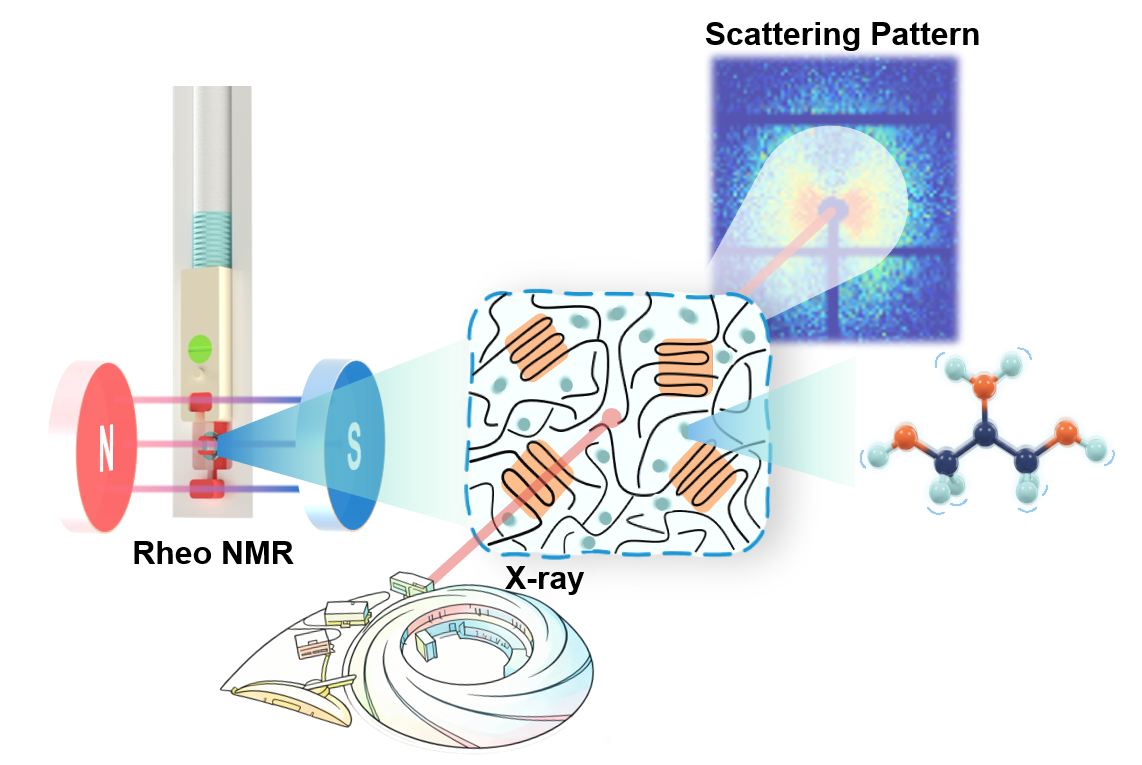
Zishuo Wu, Haotian Wu, and colleagues in our team, under the supervision of Professor Wei Chen, investigated the coupling between macroscopic mechanical behavior and microscopic solvent dynamics in polymer organogels. By combining in situ Rheo-NMR with synchrotron radiation X-ray scattering (SRXS), the team revealed for the first time a temperature-dependent coupling between macroscopic deformation and microscopic solvent confinement. The findings were published in Polymer.
In this study, the team performed in situ tensile tests on poly(vinyl alcohol) (PVA) organogels at different temperatures to systematically investigate how the dynamics of the solvent molecules (glycerol) evolve during deformation. The experiments showed that, at relatively low temperatures, such as 40 °C, the polymer network underwent only limited reorganization, primarily involving crystallite fragmentation, while solvent dynamics remained largely undisturbed. At elevated temperatures (T ≥ 100 °C), however, markedly different dynamic behavior emerged: the mobility of glycerol molecules, as characterized by the NMR T2 relaxation time, became significantly restricted during stretching.
In situ synchrotron X-ray scattering revealed the structural origin of this counterintuitive behavior: competition between stretching-induced crystallite fragmentation and crystallization within the polymer network. At elevated temperatures, strain-induced crystallization (SIC) predominated over crystallite fragmentation, increasing the density of physical crosslinks and thereby reducing the free volume accessible to the solvent through changes in network topology. In addition, newly formed crystals gave rise to extended rigid amorphous regions, constituting the rigid amorphous fraction (RAF), at the polymer–solvent interface. These regions strongly hindered the rotational and translational motion of solvent molecules. The findings indicate that network restructuring, rather than chain orientation alone, is the key factor governing the stiffness of the system and the restriction of molecular dynamics.
This work establishes a direct correlation between stretching-induced microstructural evolution and solvent dynamics, demonstrating that the solvent is not merely a passive filler but is strongly dynamically coupled to the polymer network. These findings deepen our understanding of deformation mechanisms in soft gel materials and provide a new perspective and a theoretical basis for designing high-performance soft materials, such as advanced ion-conducting gels and freeze-resistant elastomers, through “solvent engineering.”
This work was supported by the National Natural Science Foundation of China (52422302 and U20A20256) and the Anhui Provincial Natural Science Foundation (2308085UM02 and 2408055UM001). The authors also acknowledge beamline BL16B1 at the Shanghai Synchrotron Radiation Facility (SSRF) for assistance with the measurements.
Wu, Z.; Wu, H.; Wu, L.; et al. Stretching-induced restricted solvent dynamics in polymer organogels investigated using in-situ Rheo-NMR and X-ray scattering. Polymer 2026, 359, 130245.
Paper Link: https://doi.org/10.1016/j.polymer.2026.130245