
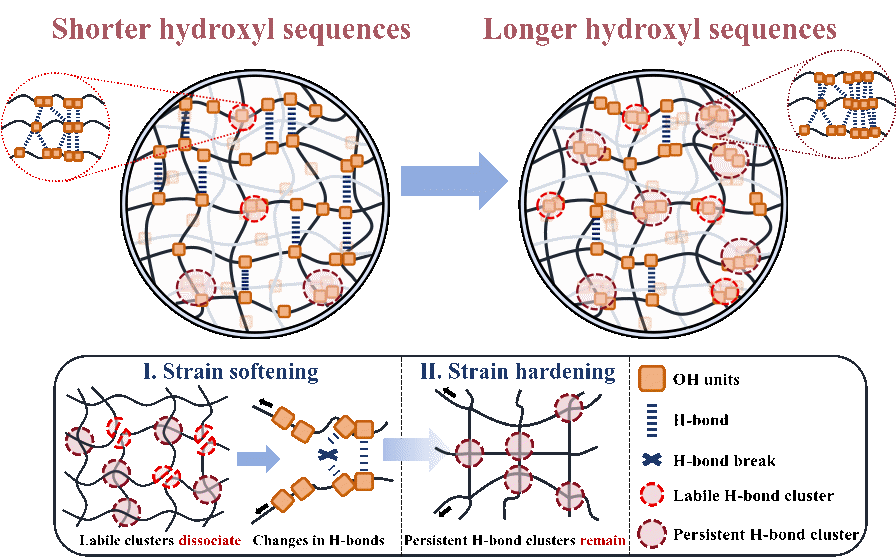
Doctoral student Menglan Qiao and colleagues in our team, under the supervision of Professor Kunpeng Cui, investigated the effects of hydroxyl sequence length on intermolecular hydrogen-bond association and tensile mechanical behavior in random poly(vinyl butyral) (PVB). The work was published in Polymer.
In this work, we focused on sequence-structure effects that are difficult to isolate in random polymers. In previous studies, changes in sequence arrangement were often accompanied by variations in molecular weight and its distribution, making it difficult to determine how local sequence structure influences intermolecular interactions and macroscopic mechanical properties. To address this issue, we used the same poly(vinyl alcohol) (PVA) precursor and varied the acetalization conditions to prepare four sets of PVB samples with comparable average degrees of acetalization, molecular weights, and molecular weight distributions, but different average hydroxyl sequence lengths. By combining quantitative nuclear magnetic resonance, infrared spectroscopy, uniaxial tensile testing, and all-atom molecular simulations, we found that increasing the average hydroxyl sequence length from 1.43 to 2.15 shifted the O–H stretching absorption band toward lower wavenumbers and increased both the number of intermolecular hydrogen bonds and the proportion of strong hydrogen bonds. These results indicate that longer hydroxyl sequences promote local cooperative association among neighboring hydroxyl groups, leading to the formation of hydrogen-bond clusters. Meanwhile, Young’s modulus increased from 6.81 MPa to 13.7 MPa, the tensile stress at a fixed strain increased, and slight strain softening and an earlier onset of strain hardening were observed. Further analysis showed that relatively weak hydrogen-bond clusters dominated by hydrogen bonds of moderate strength could partially dissociate during stretching, reducing the number of effective physical crosslinks and giving rise to slight strain softening. In contrast, clusters rich in strong hydrogen bonds could persist over the deformation timescale, acting as quasi-permanent physical crosslinks that promote strain hardening. Molecular simulations further suggested that excessively long hydroxyl sequences may suppress intermolecular hydrogen-bond formation because of steric hindrance and local structural shielding. This work elucidates how hydroxyl sequence structure affects the mechanical behavior of random polymers by regulating local hydrogen-bond association and effective physical constraints, providing new insights into molecular design and property control in hydrogen-bonding polymers.
This work was supported by the National Natural Science Foundation of China (U2430213 and 52273028), the Chinese Academy of Sciences (JZHKYPY-2021-04), and the Anhui Provincial Natural Science Foundation (2308085UM01). The authors thank Anhui Wanwei for providing the PVA samples.
Qiao, M.; Luo, T.; Li, W.; Zhang, J.; Huang, L.; Zhu, J.; Li, L.; Yan, Q.; Cui, K. Influence of sequence structure on intermolecular hydrogen bonding and mechanical properties of random poly(vinyl butyral). Polymer 2026, 367, 130971.
Paper Link: https://doi.org/10.1016/j.polymer.2026.130971